
You're reviewing a patient's medications.
"Anything else you take regularly?"
"Just something to help me sleep."
Easy enough.
"What do you take?"
They pause.
"Melatonin. Sometimes Benadryl. And magnesium."
Another pause.
"Oh, and a gummy."
There it is.
"Something for sleep" can mean a lot of things.
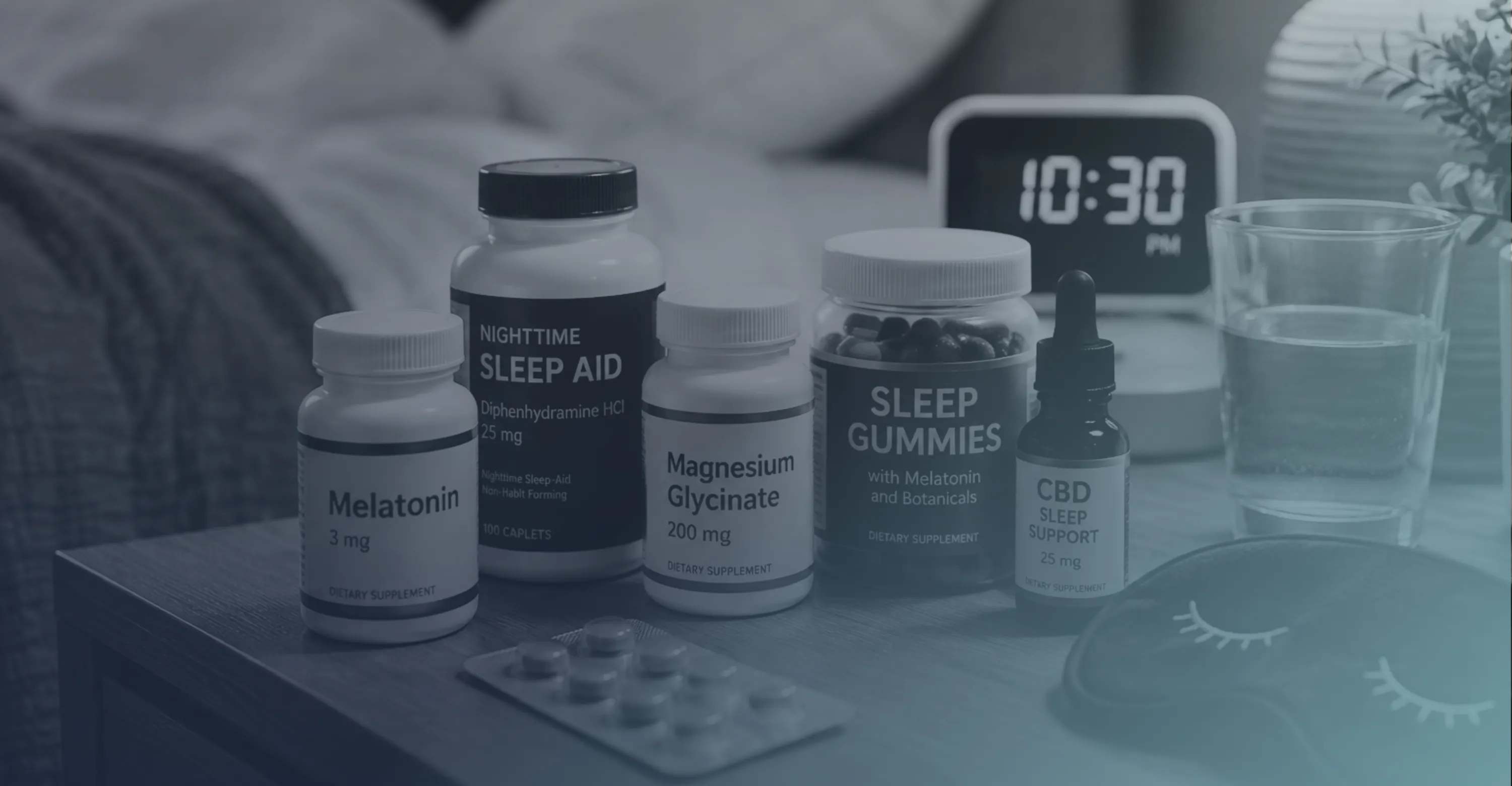
For one patient, it is 3 mg of melatonin. For another, it is diphenhydramine every night. Someone else is taking magnesium because their favorite podcast told them to. Another patient has a THC gummy on the nightstand, plus a prescription sleep medication they forgot to mention.
Sometimes they are taking more than one.
As pharmacists, we know that "sleep aid" is less a medication category than a very large bucket of things people hope will make them unconscious by 10:30.
And it is worth finding out what is actually in the bucket.
Melatonin: The Obvious One
Melatonin has become practically synonymous with sleep.
It comes in tablets, capsules, liquids, gummies, extended-release formulations, and doses ranging from tiny to surprisingly ambitious.
But melatonin is not simply an over-the-counter sleeping pill.
Its clearest role is related to circadian timing. Evidence supports its use in situations such as jet lag and some circadian rhythm sleep disorders. For chronic insomnia, the evidence is much less compelling. AASM Clinical Practice Guidelines have recommended against melatonin as a routine treatment of chronic insomnia because evidence of meaningful benefit is limited.
There is another wrinkle.
In the United States, melatonin is regulated as a dietary supplement rather than a drug. What is printed on the bottle may not perfectly reflect what is inside it.
One study of 25 melatonin gummy products found that 22 were inaccurately labeled. Among products containing detectable melatonin, the measured quantity ranged from 74% to 347% of the amount listed on the label.
That makes "I take a melatonin gummy" a useful starting point, but not necessarily the whole medication history.
How much?
Which product?
Every night?
And perhaps most importantly: Is it working?
Diphenhydramine: The Accidental Sleep Medication
Then there is Benadryl.
Or Tylenol PM.
Or Advil PM.
Or a generic bottle that says "nighttime sleep aid" in reassuring purple letters.
Patients may not realize that several of these products rely on a sedating first-generation antihistamine such as diphenhydramine.
They know it makes them sleepy.
So they take it to sleep.
The problem is that sedation is not quite the same thing as treating insomnia.
Tolerance to the sedating effects can develop, and anticholinergic adverse effects become particularly concerning in older adults. Dry mouth and constipation may be annoying. Confusion, urinary retention, falls, and next-day impairment can be considerably more consequential.
There is also the combination-product problem.
A patient taking Tylenol PM may tell you they take "Tylenol at night."
What they may not realize is that they are also taking diphenhydramine every night.
The front of the box is not always a medication reconciliation tool.
Magnesium: The Internet's Favorite Mineral
Magnesium has had quite a career change.
Once mostly associated with constipation, supplementation, and electrolyte replacement, it has become a social-media sleep celebrity.
Magnesium glycinate in particular is now routinely promoted for relaxation and better sleep. There is even the "sleepy girl mocktail," a social media concoction commonly built around magnesium.
The evidence is less exciting than the internet would have you believe.
Research on magnesium for insomnia remains limited. Some small studies from NIH suggest possible improvements in sleep onset latency in older adults with insomnia, but reviews have found the evidence insufficient or conflicting.
That does not mean magnesium is useless.
It means "everyone online says this helps with sleep" and "we have strong evidence that this treats insomnia" are not the same sentence.
It is also worth knowing how much the patient is taking. Supplemental magnesium can cause diarrhea, nausea, and abdominal cramping, particularly at higher doses.
Sometimes the reason your patient keeps waking up at night is the thing they started taking to help them sleep.
"And Sometimes I Take a Gummy"
This is where specificity becomes important.
A "sleep gummy" might be melatonin.
It might contain THC or CBD.
It might contain magnesium plus melatonin plus several botanicals.
It might contain ingredients the patient cannot name without retrieving the bottle from their bathroom.
The important thing is not to assume.
Ask what is actually in it.
Cannabis products deserve particular attention when patients are also taking other medications that cause sedation or cognitive impairment. The same general principle applies to multi-ingredient sleep supplements.
More ingredients do not necessarily mean more sleep.
They do mean more things to put on the medication list.
The Prescription Sleep Medication They Forgot About
Then, of course, there are prescription medications.
Zolpidem. Eszopiclone. Trazodone. Doxepin. Benzodiazepines. Orexin receptor antagonists.
And occasionally a medication prescribed for another reason that the patient has discovered makes bedtime considerably easier.
These are much more likely to appear on the medication list.
But that does not mean the clinician knows what else the patient is stacking around them.
A prescription hypnotic plus a glass of wine is one conversation.
A prescription hypnotic plus diphenhydramine plus a THC gummy is another.
The individual products are only part of the story.
The combination matters.
Maybe the Better Question Is: Why Aren't You Sleeping?
There is an easy trap here.
Patient cannot sleep.
Patient takes sleep aid.
We discuss sleep aid.
But insomnia is a symptom, not a deficiency of nighttime gummies.
Is the problem falling asleep?
Staying asleep?
Waking too early?
Restless legs?
Pain?
Anxiety?
A medication that is keeping them awake?
Caffeine at 5 p.m.?
Untreated sleep apnea?
Or simply not giving themselves enough opportunity to sleep?
For chronic insomnia, cognitive behavioral therapy for insomnia, or CBT-I, remains a first-line treatment.
That may not be what someone wants to hear when they are standing in the supplement aisle looking for the bottle that promises "deep restful sleep."
But it is an important distinction.
Sometimes the most useful medication intervention is realizing that the problem may not need another medication.
Ask What "Something for Sleep" Actually Means
Patients do not always think of OTC products, supplements, or gummies as medications.
So "What medications are you taking?" may not capture them.
A more useful follow-up can be surprisingly simple:
"What do you take when you can't sleep?"
Melatonin?
Diphenhydramine?
Magnesium?
A gummy?
A prescription?
All of the above?
Suddenly, "something for sleep" becomes a much more interesting medication history.
And occasionally, the thing keeping your patient from feeling rested is sitting right there on the nightstand.
Sources
- https://jamanetwork.com/journals/jama/fullarticle/2804077
- https://pmc.ncbi.nlm.nih.gov/articles/PMC5263087/
- https://pmc.ncbi.nlm.nih.gov/articles/PMC12478568/
- https://www.nccih.nih.gov/health/in-the-news-magnesium-supplements-for-sleep-disorders
- https://ods.od.nih.gov/factsheets/Magnesium-HealthProfessional/
- https://www.fda.gov/consumers/consumer-updates/what-you-need-know-and-what-were-working-find-out-about-products-containing-cannabis-or-cannabis
- https://pmc.ncbi.nlm.nih.gov/articles/PMC7853203/