
Historically, atopic dermatitis (AD or eczema) was viewed primarily as a chronic inflammatory skin condition. Over the past decade, however, research has revealed that AD is far more than simply dry skin, arising from a complex interaction of genetics, immune dysregulation, skin barrier dysfunction, the skin microbiome, and environmental exposures.
As a pre-med student who has lived with AD since birth, I've always been curious about why the condition remains so widely misunderstood despite affecting millions of people. That curiosity led me to speak with Dr. Chase Kwon, a board-certified dermatologist at the Dermatology Institute of Chicago, whose career includes NIH-funded research and publications focused on actinic keratosis, ethics, psoriasis, and atopic dermatitis. Our conversation explored how our understanding of AD has evolved and is now transforming the way physicians across specialties recognize, diagnose, and manage eczema.
Why AD is More Than "Just Eczema"
Although AD is commonly associated with intense itching, dry skin, and frequent rashes, disease severity and presentation vary widely depending on age, skin tone, genetics, immune activity, and environment. Because no single factor fully explains disease development, AD is now referred to as a multifactorial condition – an important concept for primary care providers (PCP), pediatricians, or general practitioners who may be the first to evaluate patients with suspected eczema.
Genetics have long been recognized as contributing to AD, with a family history of atopic disease increasing risk. Dr. Kwon noted, "Researchers have identified genes like filaggrin that play an important role in maintaining the skin barrier" (Kwon, 21:19). Together with a patient's family history, these discoveries can help physicians better recognize those at increased risk for AD. Beyond genetic risk, dysregulated type 2 immune responses contribute to the chronic inflammation characteristic of AD. While immune dysregulation is central to the disease, AD is considered immune-mediated rather than autoimmune.
Filaggrin helps maintain the integrity of the skin barrier. Mutations in the filaggrin gene—or reduced expression—weaken that barrier, decreasing moisture retention and allowing allergens, pollutants, and microbes to penetrate more easily.
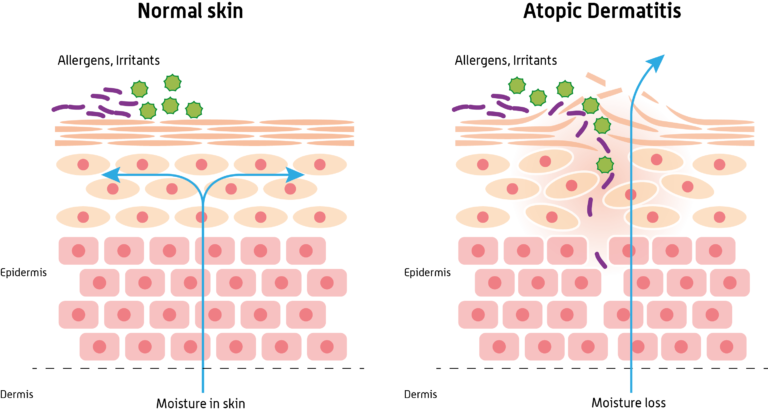
Dr. Kwon explained that "reduced microbial diversity" in the skin microbiome is associated with increased colonization by Staphylococcus aureus, further contributing to inflammation (Kwon, 20:45). Understanding these mechanisms can help clinicians tailor treatment decisions and educate patients on the importance of skin barrier repair.
What Should Those in an AD Care Team Know?
Because primary care physicians (PCPs) are often the first clinicians to evaluate patients with suspected AD, recognizing its varied clinical presentations is essential. Dr. Kwon emphasized considering skin tone, age, disease stage, and family history during evaluation. Skin tone can significantly influence the appearance of AD. For instance, fair-skinned individuals typically display eczema as red, weepy lesions with lichenification. In contrast, Dr. Kwon mentioned that "in patients with darker pigmentation . . . we may see more of that papular presentation," while, "in Asian patients, I've seen patients where the eczema appears more psoriasiform, so it gets misdiagnosed as psoriasis" (Kwon, 1:08; Kwon, 00:45). Limited familiarity with these varied expressions can impact a patient's care through delayed diagnosis or misdiagnosis.
Disease presentation also varies by age and disease state. AD in infants typically presents on the face or extensor surfaces, whereas older children and adults more commonly develop flexural disease. Acute flares may feature vesicles, while chronic disease is characterized by lichenification, helping distinguish AD from other inflammatory conditions.
For patients with findings suggestive of eczema, Dr. Kwon recommends considering atypical presentations rather than ruling out AD when lesions appear psoriasiform or papular. When diagnostic uncertainty exists, early dermatology referral is appropriate. However, if AD is strongly suspected, PCPs can begin treatment with "bland emollients" or "minimally allergenic moisturizers" and topical corticosteroids while patients await specialty care (Kwon, 18:24).
Applying Emerging Science to Everyday Clinical Practice
As our understanding of atopic dermatitis continues to evolve, so too does the role of physicians across specialties. Recognizing that AD is more complex than simply dry skin—and appreciating the genetic, immunologic, and environmental diversity that shape each patient's disease—can improve diagnostic accuracy, facilitate timely referrals, and support more appropriate treatment. For clinicians on the front lines of patient care, this knowledge offers an opportunity to intervene earlier and significantly improve long-term outcomes.
Speaking with Dr. Kwon allowed me to explore beyond the published research and hear how advances in AD science influence patient care every day. As someone who lives with atopic dermatitis and is preparing for a career in medicine, the conversation reinforced that scientific advancements are only as meaningful as our ability to apply them in clinical practice. For me, it was a reminder that the future of medicine depends not only on new discoveries, but also on physicians who incorporate those findings into better patient care.