
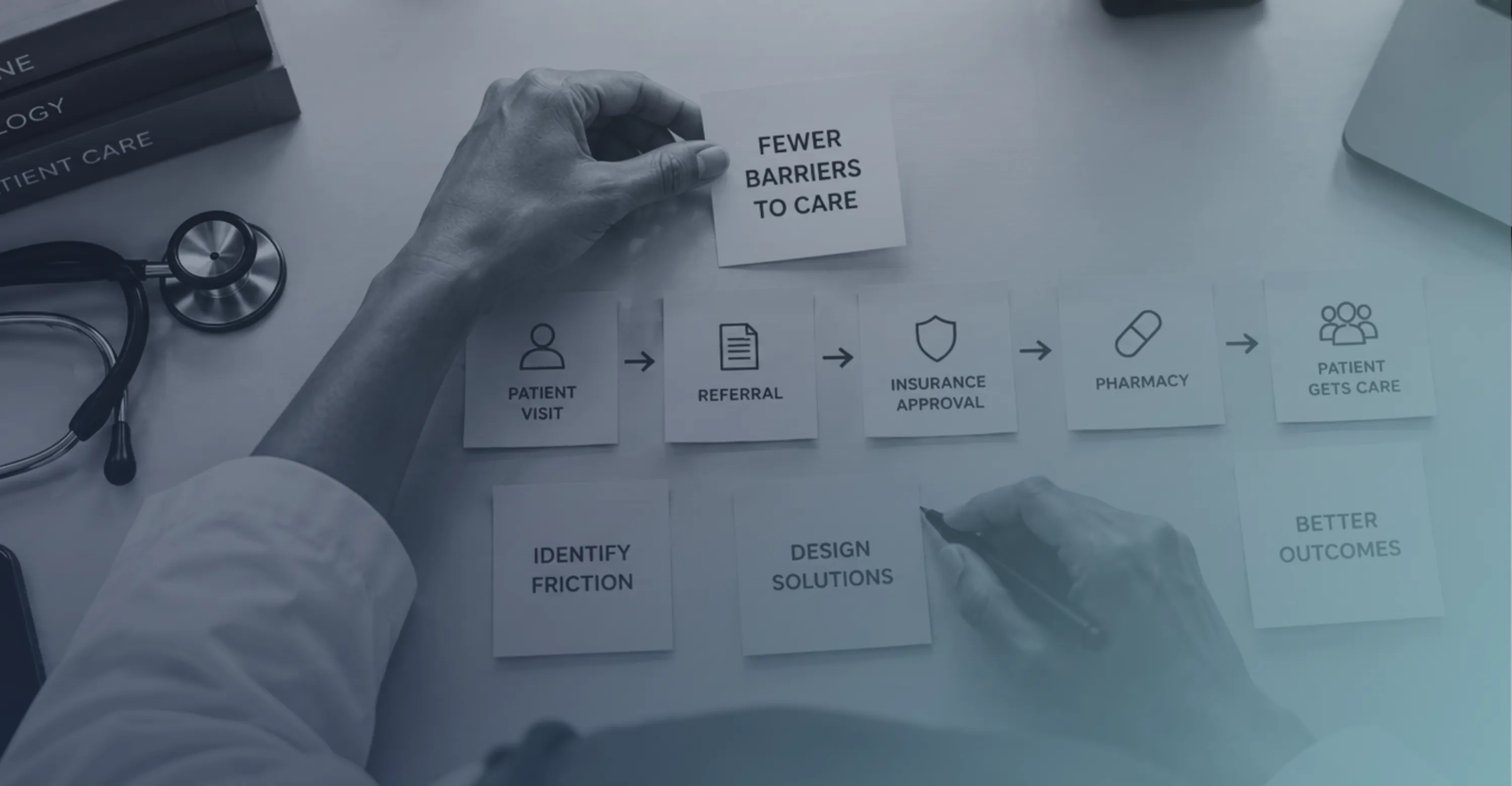
Five practical ways to start, without learning to code or leaving clinical practice.
Healthcare technology can feel like a separate ecosystem, with its own language, rules and roles.
It is easy to assume that contributing meaningfully requires a background you don't have. It does not.
The best place to begin is with the work you already do, and the problems you see every day.
1. Start With the Friction You Already See
Physicians encounter the healthcare system's friction constantly. You see the referral that never gets scheduled, the prior authorization that delays treatment, the important result buried in the electronic health record, and the patient who cannot access the next step in their care.
These moments are more than frustrations. They are insights into problems you are uniquely positioned to help solve.
So for a physician builder, the first step is not choosing a technology.
It is identifying a problem worth solving.
Pay attention to what's broken: What consumes time without improving care? Where do patients become confused or disengaged? Which tasks force you or your staff to create workarounds?
When the same problem appears repeatedly, it can signal an opportunity for better technology, workflow design, or communication.
2. You Don't Have to Be a Founder
Once you identify a problem, look inward: What strengths do you bring to solving it?
It's important to understand that healthcare innovation needs more than founders.
Consider which of these descriptions sounds most like you:
- You constantly notice broken workflows → product advising or development
- You enjoy evaluating evidence → research, clinical validation, or due diligence
- You like teaching and explaining → medical writing, education, or clinical translation
- You bring people together → community building or partnerships
- You have a problem you cannot stop thinking about → entrepreneurship
The most sustainable entry point builds on your existing strengths rather than requiring you to adopt an entirely new professional identity.
3. Start Small. Stay Clinical.
The top two myths doctors believe:
Myth 1: In order to build, I have to leave medicine.
Myth 2: If I participate in health tech, I have to start a company.
Building in medicine does not require an immediate career change.
Join a physician entrepreneurship community. Attend a healthcare hackathon, startup demonstration day, or innovation event. Look for your institution's digital health program. Volunteer to test an early product or offer clinical feedback to a startup.
From there, opportunities can become more formal: serving as a clinical advisor, joining an advisory board, contributing to research, participating in a pilot, or helping a company design and evaluate a new product.
You can start contributing without stepping away from the clinical work. In fact, your clinical work makes your perspective valuable.
4. Learn to Think Like a Product Team, Not Code Like One
Physicians should understand the fundamentals of product development, but that does not necessarily mean learning to code.
It means understanding how products are designed and tested, how companies define success, where artificial intelligence can fail, and why an impressive demonstration may not translate into better care.
When evaluating any healthcare technology, ask five questions:
- Who has the problem?
- Where does this fit into the existing workflow?
- What new work does it create?
- What happens when it is wrong or fails?
- What changes for the patient if it works?
These questions turn clinical observations into feedback that product teams can act on. They also help physicians challenge how success is measured.
5. Measure What Happens Next
Technology is not valuable because it saves a click, generates a note, or produces a clinically reasonable recommendation.
Its real value lies in what happens next. Does it reduce the burden on the care team? Does it improve access? Does it help the patient move forward?
Physicians are uniquely equipped to ask these questions because they understand both the intended workflow and its real-world consequences.
Your Move: The First 30 Days as a Physician Builder
You do not need a five-year plan. Start with one month.
During the first week, write down three recurring problems that frustrate you in your practice.
In the second, speak with colleagues to determine whether they experience the same friction.
In the third, find a physician-entrepreneurship community, innovation event, or a company working on the problem.
In the fourth, contribute: attend a meeting, test a product, or offer structured clinical feedback.
Physicians do not need permission to participate in healthcare technology. Your clinical experience is already a qualification.
The opportunity is to translate what you see every day into better questions, better products, and ultimately, better care.