Artificial intelligence (AI) has quickly become one of the most discussed topics in oncology. Every week seems to bring another announcement of a new large language model, imaging algorithm, or prediction that AI will transform cancer care. As clinicians, we have learned to be cautious about these claims. Medicine has seen many innovations that generated excitement long before they demonstrated meaningful benefit for patients.
What feels different about AI is that many of its earliest successes are not centered on replacing physician decision-making. Instead, they address problems that nearly every oncologist experiences daily: documentation burden, information overload, fragmented workflows, and the growing complexity of cancer care.
In many ways, AI is not changing what oncologists do but it is beginning to change how we do it.
Addressing One of Oncology's Biggest Challenges
Modern oncology has become an exercise in managing information. A single patient encounter may require integrating pathology, molecular profiling, imaging, laboratory data, treatment history, clinical trial eligibility, and rapidly evolving guidelines, all while documenting the visit in the electronic health record (EHR).
Documentation alone has become a major contributor to clinician burnout. Studies estimate that physicians spend more than half of the workday interacting with the EHR, with documentation averaging approximately 2.3 hours during an eight-hour patient care day.[1] Every oncologist recognizes the experience of finishing clinic only to spend the evening completing notes and responding to messages.
Not surprisingly, one of the earliest successful clinical applications of AI has focused on documentation rather than diagnosis.
Ambient AI systems combine automatic speech recognition with natural language processing to convert conversations into structured clinical notes. Beyond documentation, many platforms draft patient instructions, summarize visits, and assist with inbox management while maintaining clinician review before information enters the medical record.[2]
Importantly, these systems are beginning to demonstrate measurable benefits. In a multicenter study involving 263 ambulatory clinicians across six U.S. health systems, implementation of ambient AI scribes was associated with significant reductions in burnout, cognitive workload, and after-hours documentation after only 30 days.[3] More recently, a multisite analysis of more than 8,500 clinicians found reductions in overall EHR time and documentation time, with the greatest improvements observed among high-frequency users, advanced practice clinicians, and primary care physicians.[4]
Although these studies primarily evaluated operational outcomes rather than patient-centered endpoints, they suggest that AI may help address one of the greatest challenges facing oncology today: allowing clinicians to spend less time documenting and more time caring for patients.
AI Is Becoming Another Clinical Tool
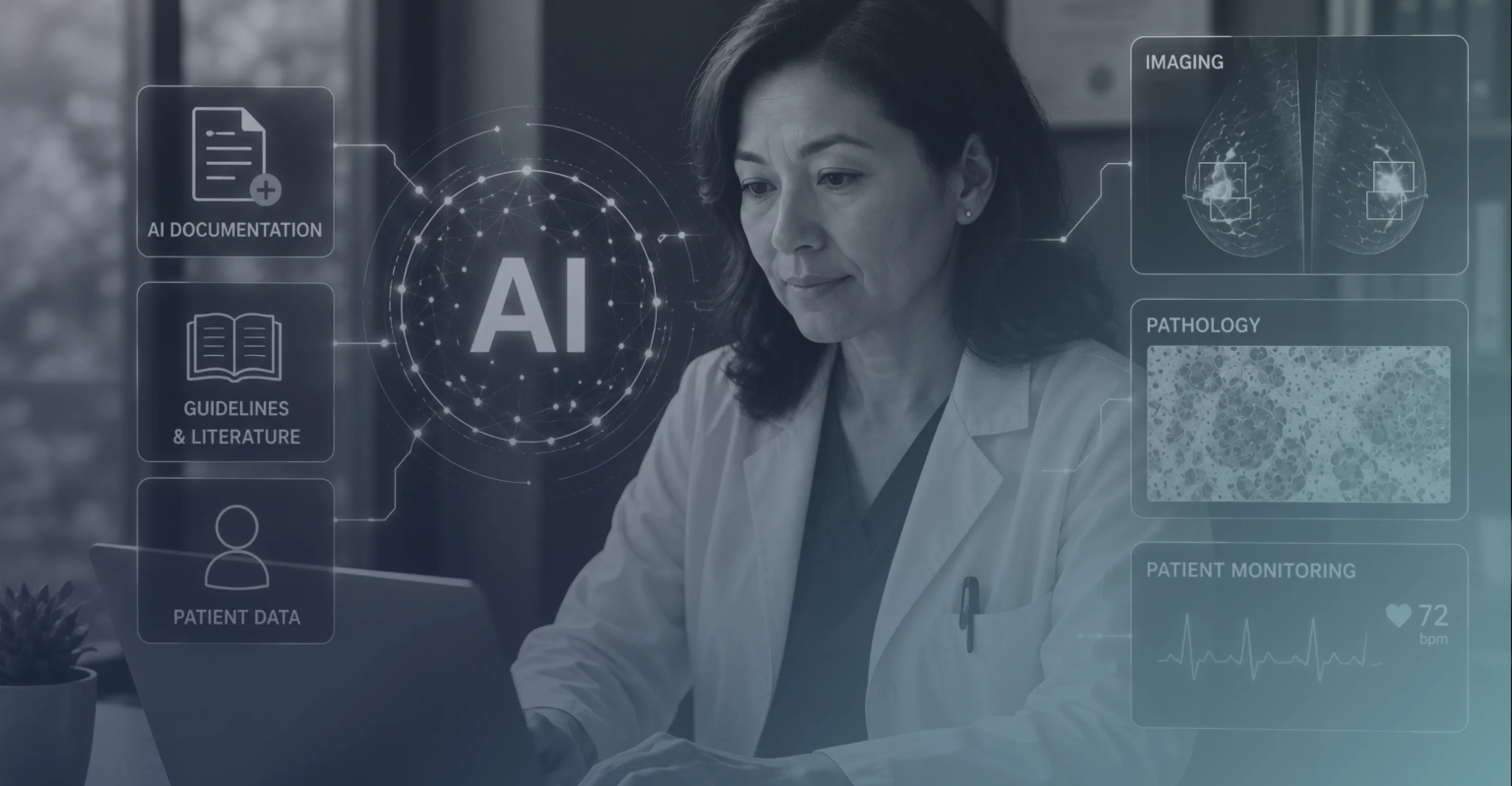
Beyond documentation, AI is increasingly being integrated throughout the cancer care continuum.
In breast imaging, AI-assisted mammography has improved cancer detection while reducing radiologist workload without increasing false-positive examinations.[5] Image-only risk prediction models have also demonstrated the ability to identify women at elevated five-year breast cancer risk directly from screening mammograms, supporting more personalized screening strategies beyond traditional risk assessment models.[6]
Digital pathology is following a similar trajectory. Deep learning models can extract clinically relevant information from whole-slide images, identifying histologic patterns associated with prognosis, molecular alterations, and treatment response.[2] More importantly, AI has begun moving beyond proof-of-concept studies into clinical implementation. AI-enabled prognostic tools for localized prostate cancer have been incorporated into NCCN Guidelines, while multimodal AI models in breast cancer continue to demonstrate improved risk stratification across large randomized clinical trial datasets.[7,8]
These developments highlight an important principle. AI is not replacing radiologists or pathologists. Instead, it provides another layer of information that clinicians integrate alongside imaging, pathology, molecular testing, and clinical judgment.
From Information Overload to Knowledge Support
If documentation is one challenge facing oncology, information overload is another.
New clinical trials, biomarker-driven therapies, and guideline updates are published at a pace that makes comprehensive review increasingly difficult. AI-based clinical decision support aims to organize this expanding body of knowledge rather than replace physician reasoning.
Generative AI systems can summarize literature, identify relevant publications, and synthesize evidence more rapidly than traditional manual review. Retrieval-augmented generation (RAG) systems extend these capabilities by integrating current guidelines, published literature, and structured clinical data to generate responses grounded in contemporary evidence.[9] Recognizing this potential, ASCO has introduced an AI-powered Guidelines Assistant designed to improve clinician access to evidence-based recommendations.
However, these tools also have important limitations. Large language models may hallucinate references, omit methodological details, or misinterpret study findings.[2,9] In oncology, where treatment recommendations often depend on subtle differences in stage, biomarkers, or prior therapy, these limitations are particularly relevant.
For that reason, AI should function as an evidence-navigation tool and not an evidence-replacement tool.
Extending Oncology Beyond the Clinic
Some of the most important changes in a patient's condition occur between scheduled clinic visits.
Treatment-related toxicities, fatigue, declining functional status, and psychosocial distress often develop gradually, yet clinicians typically assess them only during intermittent encounters.
Wearable devices, patient-reported outcomes, and remote monitoring technologies offer an opportunity to change this model. AI can integrate physiologic data, activity patterns, sleep metrics, laboratory values, and patient-reported symptoms to identify early signals of clinical deterioration.[10]
AI-supported survivorship platforms are also being evaluated to personalize follow-up care, organize survivorship care plans, and identify patients requiring additional supportive care resources.[10] Although early studies suggest improvements in patient activation and quality of life, larger prospective studies are still needed before implementation.
These technologies may help clinicians intervene earlier by recognizing clinically meaningful changes before patients return to the office.
Implementation Will Determine Success
As enthusiasm for AI grows, it is important to remember that implementation matters as much as innovation.
Every predictive model requires external validation. Performance varies across patient populations and healthcare systems. Poorly integrated AI may contribute to alert fatigue, automation bias, or clinician distrust. Data quality remains the foundation upon which every algorithm depends.
Before integrating any tool into routine practice, clinicians should ask familiar questions: Has it been externally validated? Does it improve meaningful outcomes? Does it perform across diverse patient populations? Does it enhance workflow without compromising patient safety?
Looking Ahead
AI is going to become an integral part of oncology. The real challenge is ensuring these tools are implemented responsibly, with rigorous validation, clinician oversight, and a continued focus on patient-centered care.
The future of oncology is unlikely to be AI versus physicians. It will be physicians who know how to thoughtfully integrate AI into practice while keeping patients at the center of every decision.
References
- Pearlman K et al. JAMA Netw Open. 2025. doi:10.1001/jamanetworkopen.2025.37000
- Riaz IB, Khan MA, Osterman TJ. Artificial intelligence across the cancer care continuum. Cancer. 2025;e70050. doi:10.1002/cncr.70050
- Olson KD, Meeker D, Troup M, et al. Use of Ambient AI Scribes to Reduce Administrative Burden and Professional Burnout. JAMA Netw Open. 2025;8(10):e2534976. doi:10.1001/jamanetworkopen.2025.3497
- Rotenstein LS, Holmgren AJ, Thombley R, et al. Changes in Clinician Time Expenditure and Visit Quantity With Adoption of Artificial Intelligence-Powered Scribes. JAMA. 2026;335:1408-1417.
- Hernström V, Josefsson V, Sartor H, et al. Lancet Digital Health. 2025;7.
- Lehman CD, Kuhl C, et al. Image-only AI model compared with breast density for identifying women at 5-year increased risk of breast cancer. Presented at RSNA 2025.
- Spratt DE, et al. Artificial Intelligence Predictive Model for Hormone Therapy Use in Prostate Cancer. 2023.
- Geyer CE, et al. Development of a Multimodal Artificial Intelligence Model for Predicting Distant Metastasis in HR-positive Early Breast Cancer. SABCS 2025.
- Thaker NG, Liu W, Waddle M, et al. Retrieval-Augmented Generation in Oncology: Promises, Pitfalls, and Early Applications. AI in Precision Oncology. 2026.
- Bitterman DS, Downing A, Maués J, Lustberg M. Promise and perils of large language models for cancer survivorship and supportive care. Journal of Clinical Oncology. 2024.